LIZ + THE BAGUETTES
  • Home
  • About
  • Press Room
  • Contact
  • Store
  • Bloguette

October 27th, 2023

10/27/2023

0 Comments

 
As a teenager, I spent months drawing with nothing but Sharpie; my art teacher wanted me to get comfortable with not being able to erase. After contour and texture studies, we progressed to working with negative space—that is, defining an object by what's around it. 
A drawing of silhouetted leaves in white against a black background.
What was I doing at 14? Drawing the black fabric behind branches.
I'm working on a song about someone who's not there, and as often happens, the lessons appeared right when I needed them.

Austin Kleon posted this gem about punk artists defining their work by negatives, with a nice quote from David Byrne on how the Talking Heads set out not to do certain things other bands had done. "The only sensible course was to avoid all of it, to strip everything back and see what was left. ...It was mathematics; when you subtract all that unwanted stuff from something, art or music, what do you have left?" Byrne adds that he later moved beyond that approach, "but the dogma provided a place to start."

In a Chicago rock discussion group, someone posted Paul Westerberg's interview with Musician, in which he discusses how artists define themselves in relation to others, whether they're aspiring to be in the in-group or to break away: "It takes a lot of courage to be different but it takes a great deal of hard work to be the same. I think in the end you get the same result but you've got to be what you are." (I've always had the impression that Westerberg had little choice about being different; he's constitutionally perverse. In Trouble Boys he says that if you tell him "White sheet rain," he'll come back with "Black blanket sun.")

What do those things mean for the song? for me as a person? Defining by absence is useful, but there's a point at which it becomes too reductive. What isn't starts to obscure what is and what can be. I was stuck on a refrain of "I won't think about you, I won't think about you" until I figured out that it needed to break so the song could become a whole song, not just an idea. Ultimately the no isn't enough; you need the yes too. Or I do. 
0 Comments

Notebook Thursday: Elegies

10/12/2023

1 Comment

 
A few weeks ago, to general woe, Café Selmarie announced it would be closing. I've lived a block away for the past eleven years, and being able to wander through Giddings Plaza for a perfect croissant or a cup of veg chili has always been one of the best parts of the neighborhood.

Right after the announcement I took an evening walk down Lincoln. The windows of another restaurant were papered over. The urgent care clinic sent fluorescent light out of what used to be the Brauhaus. By the fountain a familiar cellist was playing a Bach melody I've learned by heart this year. It felt like an elegy for the Square as I have known it, for this whole stretch of my life.

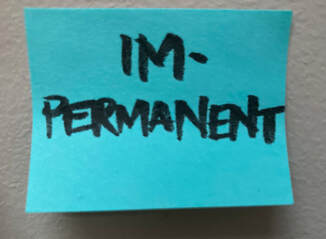
We cling to the illusion of permanence because it provides the even more important illusion of security. Or that's what I told myself as the streetlights came on against a blue twilight.

I moved out last week. This blog is not the place to go into the details, but the past couple of years have been the hardest of my life. Sometimes the difficulty seemed permanent in a way that began to feel secure, which terrified me.

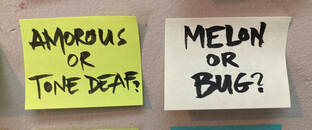
I've left behind the music room where we recorded most of Highway Gothic and a lot of Unswept tracks. The hundred-year-old piano from "Gen X" and "After All" is still in the front room. My sticky-note project is still on the wall; I will collect it at some point, but inevitably pieces will be shuffled and jumbled. It won't be the same. Nothing will. 

Bach is a good choice for an elegy. His music provides a sense of having tapped into a deeper natural order—and I still don't know whether it's an actual natural order or merely the comforting illusion of one, rendered exceptionally well. The cello suite dances on a sharp edge of paradox, offering permanence in a melody, something that vanishes even as you experience it. Perhaps that, in itself, is the natural order.
1 Comment

Notebook Thursday: Where You Find It

8/24/2023

0 Comments

 
Lots of songs in progress, nothing quite ready to share. Some things I have found inspiring of late:
  • Claire Vaye Watkins's essay "On Pandering" (which I encountered via Men Yell at Me). This gets at a lot of reasons I needed to take a break from writing literary fiction (after, like Watkins, being told my prose was "masculine"). And the clarion call at the end made me yell in agreement: "Let us embrace a do-it-yourself canon, wherein we each make our own canon filled with what we love to read, what speaks to us and challenges us and opens us up, wherein we can each determine our artistic lineages for ourselves, with curiosity and vigor, rather than trying to shoehorn ourselves into a canon ready made and gifted us by some white fucks at Oxford."
  • Austin Kleon's musing on middle life. I've linked to Kleon plenty before; this piece is especially lovely, and his Substack is very much worth the subscription. 
  • Van Gogh's advice to a young artist (I think this also came my way via a Substack, though now I am no longer sure which one).
  • Ted Gioia's enjoyable, if occasionally inadvertent, resistance to AI.
  • For the sake of linking to something that isn't a Substack, I'll note that one of my guitar mentors recommends dipping into Songwriters on Songwriting whenever you need a new way of looking at things.
  • The Baguettes have had a few recording sessions lately in which we've referred to Brian Eno's Oblique Strategies. Also of use: the Not So Oblique Strategies. I don't know whether it's the result of any official strategy, but last week saw us discussing whether we could incorporate a typewriter into our live percussion setup.

And it's hot. This room is so humid the trackpad on my geriatric laptop has stopped working. The world is melting, and I hope you're engaging in whatever forms of climate action you can, large and small. That's the real point of all of this: let's get rid of what isn't working, and let's make something better. 


0 Comments

Notebook Thursday: The D.I.N. approach

8/3/2023

1 Comment

 
Picture
I used to have this postcard from Found Image Press taped up over my desk. Sometime in the past couple of years it slipped down behind a stack of notebooks. But I just found it again, around the same time that Austin Kleon posted this discussion of Paul McCartney's process. One of the main points is that Paul and John followed Paul's father's advice, which he shortened to "D.I.N." In Paul's words, "you get rid of the hesitation and the doubt, and you just steamroll through." Equally important was the principle that once they sat down to work, they kept going until they had something.

Plenty can be said—and has been—for deadlines as a motivator, especially if you tend to put off creative work. (Fewer people seem to know about a study that found that a stressful deadline can actually lower your creativity for a couple of days post-project, creating what the authors called a "pressure hangover.") However, I think it's important that the D.I.N. approach, as applied by John and Paul, isn't exactly a deadline. Rather, it works like an improv game: it operates on the agreement that whatever happens here and now will be our material for now. That opens the door to spontaneity and play—which of course you can hear in the best of the Lennon-McCartney catalogue—and it yields a fantastic, if paradoxical, combination of urgency and low stakes.

My favorite music theory teacher once referred to Mozart as an essentially improvisational composer, a description that explains both his melodies and the volume of his work. You can recognize that a-ha spontaneity in many of his songs, and if you've ever sung his vocal pieces, you've had a delightful sense of discovering places your voice wants to go anyway. A lot of McCartney melodies feel the same way.

I suppose I'm coming to terms with the fact that I haven't been writing as much music as I'd like. I've made notes and starts, and then put them off, and put them off, and put them off. (There has been a whole lot of life happening, so it isn't entirely my fault, but still.) Earlier this week I pieced together some ideas—a song that has taken so long that bits of it are in three different notebooks—and sat down to "steamroll through." I didn't get it done done, but I made more progress than I have in a while. Perhaps more importantly, it seemed to throw open the door to other work—the opposite of a pressure hangover!—and by last night I had two new demos.

I'm going to find a new place for the postcard.

1 Comment

Notebook Thursday: In Praise of Cover Songs

7/20/2023

0 Comments

 
I'm playing a lot of solo cover-song gigs lately, which means spending a lot of time with other people's music. That's always a great, educational time, as long as you're not stuck in the type of gig where people just want to bellow along to "Sweet Caroline" every night. You can learn so much by finding the gaps between how you think a song goes, how it does go, and how you'd have written it. 

In many ways an acoustic cover is the real test of a song, letting you see whether melody, chords, and lyrics hold up, or whether the original is just coasting on production and performer charisma. (I once persuaded someone of the merits of "I Want It That Way" by playing the Postmodern Jukebox version. By contrast, there are any number of pop hits that I haven't added to my solo set because they turn out to be pretty boring without a big synth surge.)

This past weekend the band had a recording session that consisted mostly of cover songs (and one original so similar to early Dylan structures that it might as well be a cover). I think one definitely worked, a take of the Paul Westerberg/Grandpaboy ballad "Lush and Green" with Charlie on the lead vocal and a lot of harmonies layered in. I'm less convinced about another—still waiting to see how it sounds with a few added tracks. The treatment I initially planned didn't work, and we went in a few goofball directions from there. But these experiments are useful, even if we wind up scrapping the song. It's a nice break to work on songs that aren't mine, especially as I wrestle with the last holdout songs of Posthistoric, some of which have been in the draft stage for a couple of years. Plus, every recording session is an excuse for pie (peach rhubarb this week, not my best work, frankly, but still pie) and hanging out with Charlie and Julie's cats.

We also determined that—if we ever do chuck it all and become an all-cover act—we can play as The Imposter Syndrome. It can join The Pretenderers, Meatwood Flack, Prince and the Lauper, and the rest of the names we probably won't use.
0 Comments

Notebook Thursday: Breaks

7/13/2023

0 Comments

 
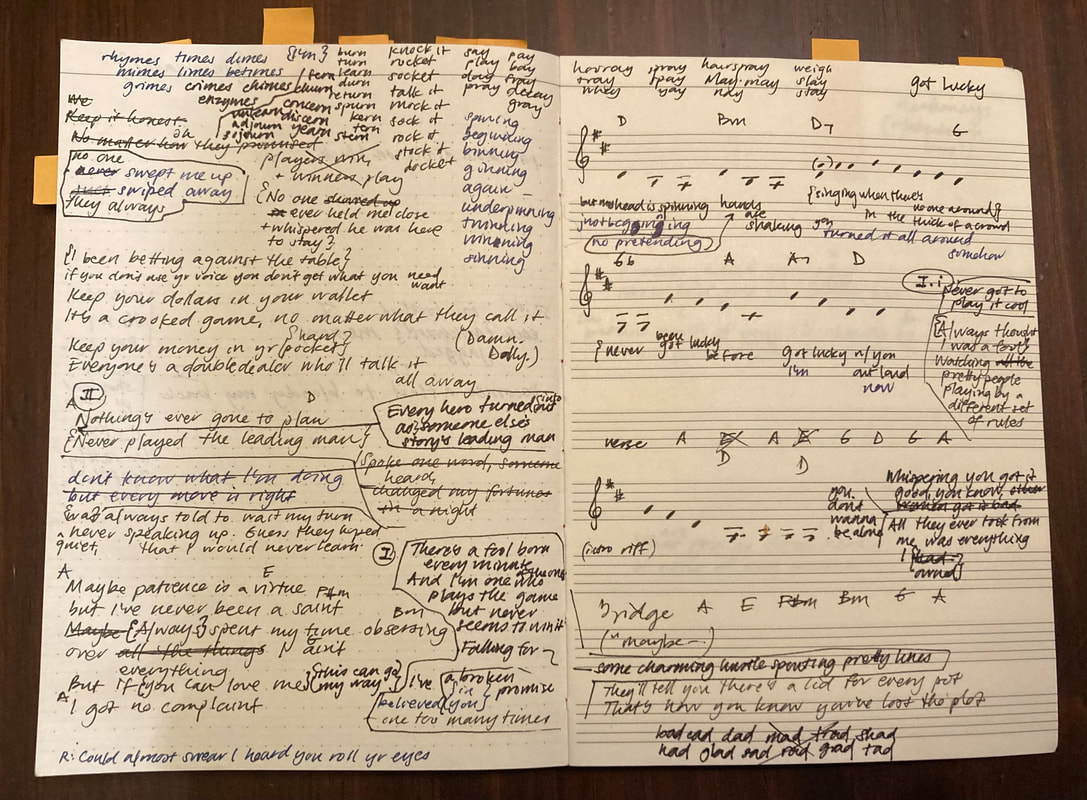
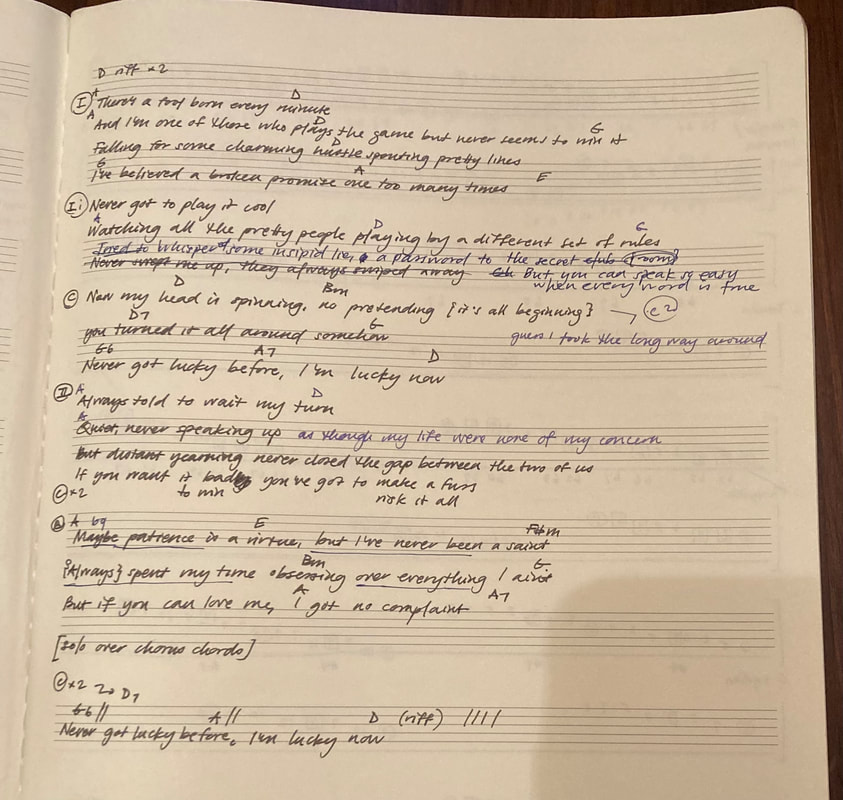
I tend to resist writing too many end-stopped lines; I like enjambment, and I really love rhyming on a nonfinal syllable, so the word breaks across the line break. ("Bourbon Trail" and "Got Lucky" probably push this tendency about as far as it can go in a standard 4/4 rock line, but I'd hate to think I'm done trying.)
Picture
Picture
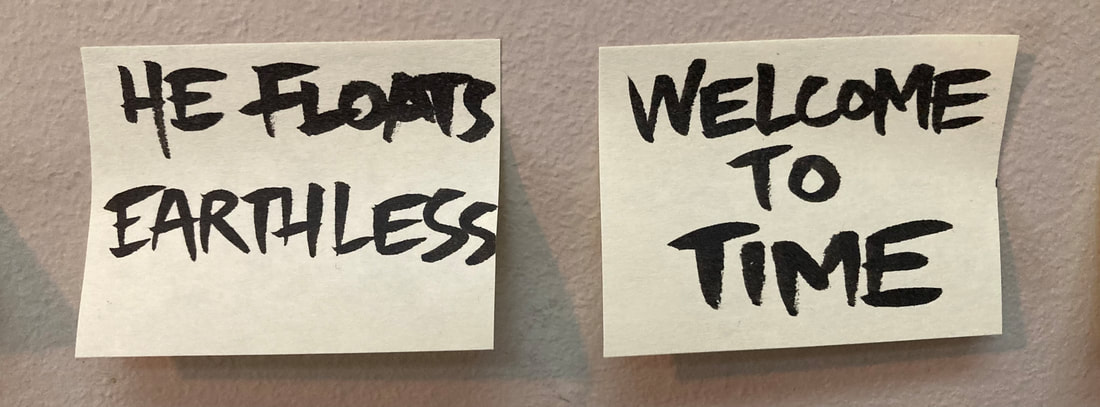
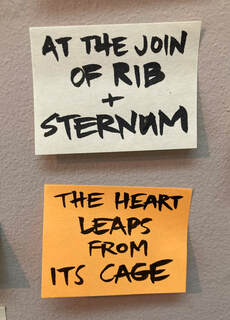
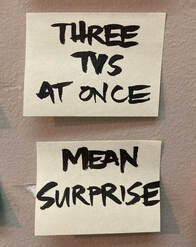
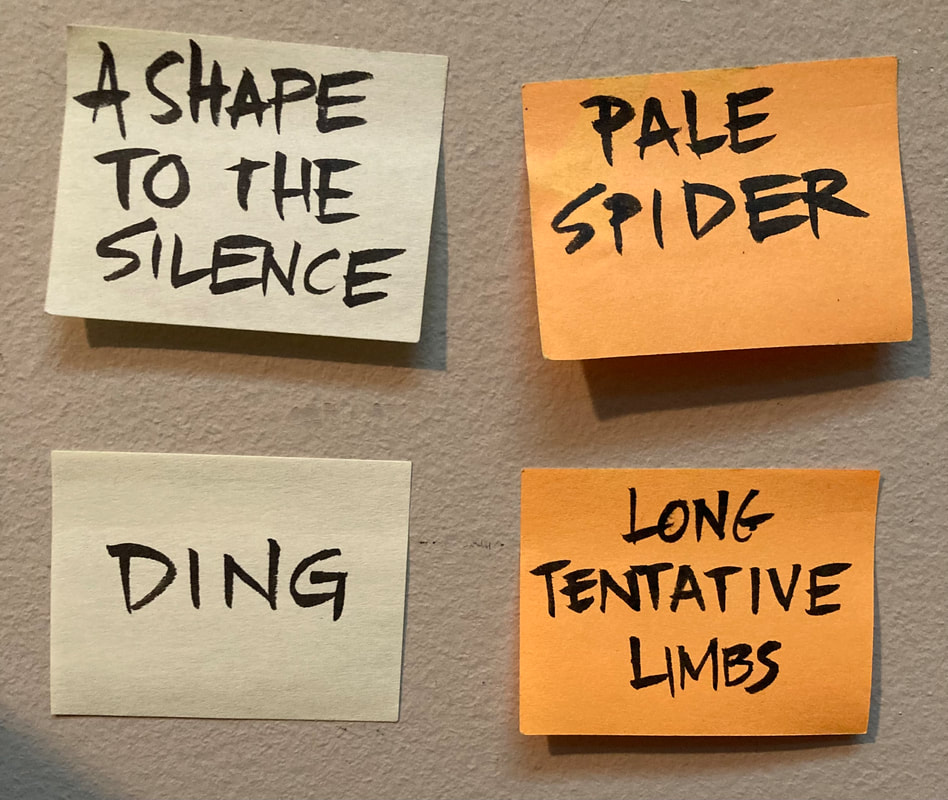
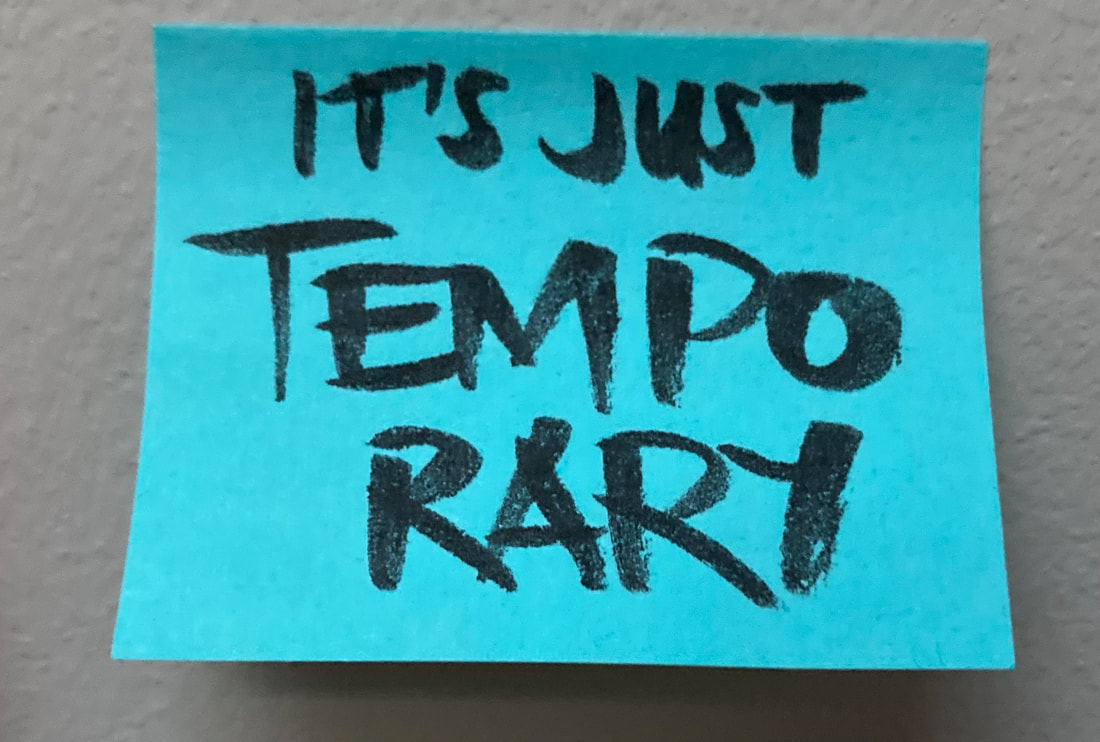
A nice, if unplanned, aspect of the sticky-note wall has been that the combination of note size and brush pen often forces a syllable break, calling attention to the words within words.
Picture
Reviewing it for this post, I'm struck by how many of the notes—and particularly how many of the broken words—involve time: WAIT FOR IT; PRECIPICE OF NEXT; HESITATE + HESITATE; TIME'S FOOL; WELCOME TO TIME. That wasn't a conscious theme of this project—it had no conscious theme—but I suppose half the point was to figure out what exactly I was thinking, pull coherence from disparate threads. 

One could make the argument—perhaps I'm making it right here!—that in time as in lyrics, the breaks make the meaning. We're all in the same forward press of minutes and seconds and days, but the points at which we stop, startled, are the ones that wind up delineating our lives. 

Maybe time is inevitably what you write about in midlife. Certainly you write about it when the album is called Posthistoric, or when a pandemic steals several years of hopes and expectations and a climate crisis threatens to truncate your age. Maybe I'm just noticing it today because a bout of insomnia last night meant that I read Philip Larkin's "Next, Please" at an unholy hour.
Picture
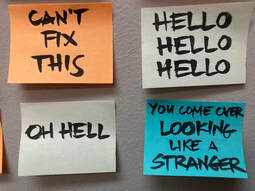
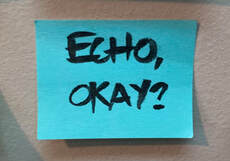
None of which is to say the project has yielded a full song yet, or that everything ties together. Two of the notes that have suggested melodies (ECHO, OKAY? and YOU COME OVER LOOKING LIKE A STRANGER) have nothing obvious to do with time—though it lurks below the surface of each one. Maybe the whole point was to startle myself, stop.
0 Comments

Notebook Thursday: Puttering

6/8/2023

0 Comments

 
A creative director at my first day job used to talk fondly of the agency where she'd started out, where designers had a timesheet code they could use for "time spent staring out the window." What she missed was the official recognition—lacking in most workplaces—that creative work demands downtime. Sometimes the brain works best when your attention wanders.

Puttering is the name I tend to give this process; apparently that's the more American word for it. UK usage favors pottering. The OED defines the verb potter as "occupy oneself in a desultory but agreeable manner; move or go about whilst occupied in such a way." The Online Etymology Dictionary adds "be busy in doing little," and notes that it seems to be a frequentative verb, similar to chatter. (Which suggests that fretter might be the verb for pottering with a guitar—if we didn't already have noodle.) It also includes a graph showing that usage of potter is about half what it was in 1800. I wonder how that graph might align with the spread of models of industrial productivity.

I, for one, have not had much time for puttering lately. I miss it, and I'm pretty sure my creative work is suffering for the lack. The sticky-note wall might qualify, since it is fundamentally aimless. But that's no more than a minute or two a day. A minute is not a lot of downtime. 

I just encountered Hanif Abdurraqib's description of an annual braided-vignette document on a random topic of interest, which can grow to hold a book's worth of words that will never be public. I love that idea, and I'm curious about what the songwriting equivalent would look like. Perhaps a rhyme/stanza game within the St. Jerome's document? The band's goofing around with parody songs and Unbelievable Truth mashups might serve a similar function. Certainly digging in to etymology does. 
0 Comments

Notebook Thursday: Drive (Guest Post)

6/1/2023

0 Comments

 
Nate Hall is an actor and musician based in Chicago. He is the composer and cowriter (with Cody Lindley) of Stabbed in the Heart, a new slasher-dramedy musical aiming for an October production. Support it with a donation or by buying tickets to its June 4 concert performance at Redline VR's Raven Room. Follow Nate on Instagram: @50firstnates

Drive is a concept that I think about every time I listen to or write music, to the point of often and rightfully deserved parody from my partner. I don’t know that my definition is one that is fully tangible, but I’ll try to break it down here.

When I’m listening to a song I’m really digging, I find myself moving my body in some way. Whether that’s a typical tapping of the foot or a less typical tightening of my shoulders while my fingers curl on a satisfying change, it’s pretty much inevitable. I crave being literally moved by the music I’m listening to.

So, drive is a way to make the music move forward. Less sitting on each beat and more jumping to the next beat too early out of pure excitement for what’s coming next. I want the listener to hop on for the roller coaster ride and put their hands up as we crest an apex, to be an active participant in the listening process.

There are a lot of ways to evoke this elation, but the most obvious to me is through syncopation. The easiest and most efficient way to surprise and intrigue, until you use it too much of course (then the boring becomes your tool of surprise, and the cycle continues). However, I wouldn’t say that a genre like jazz, practically the king of syncopation, is driving in all cases. Though the improvisation inherent in jazz creates some pockets for musicians to shock and awe their audiences, it can sometimes fall prey to its own atmosphere, becoming more of a philosophical think piece with superficially deep “hmms” and “ahs.”

That’s where the riff comes in. I love masterworks of composition by Sondheim as much as the next guy, but the opening riff to Stereogram’s "Walkie Talkie Man" that I heard on a Nintendo DS game in the early 2000s will permanently hold a spot in my brain despite anything I ever do to erase it (why would I, but point made). I love me some Joe Satriani marathon solos, but have you heard the chord progression in Carly Rae Jepsen’s "Call Me Maybe"? Cause I sure have and I am not tired of it and I think that MATTERS.
​

Picture
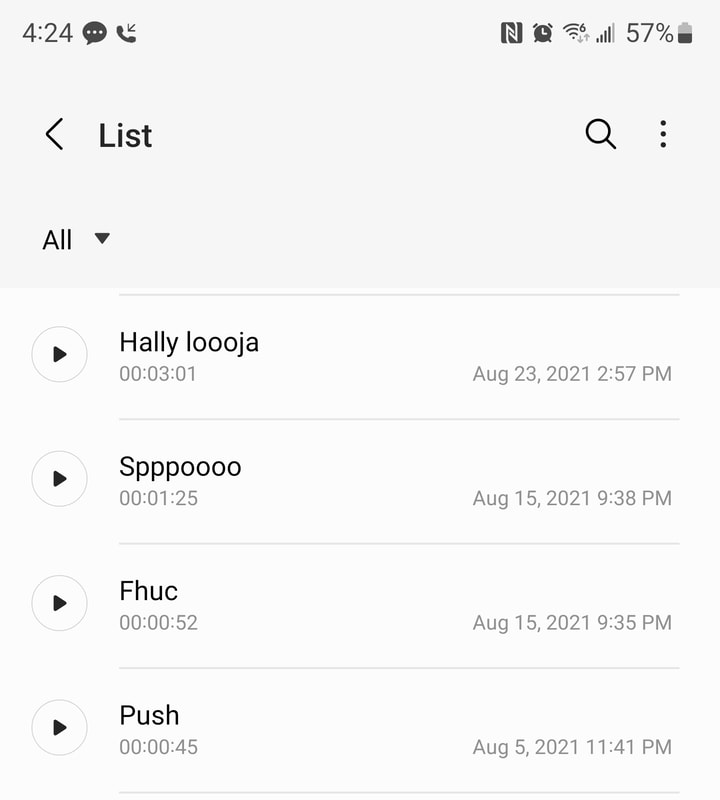
Though my process changes all the time, one constant has been basing songs off of core riffs that were fun to play and that made me want to hear the riff again, or push forward (drive, get it?). The catch is that I still need the improvisation in there somewhere to make that riff unexpected. To incorporate it, I will record a riff whenever it comes up, but then give it a title that has nothing to do with what it is. In fact, the further from the actual tone and vibe of the riff, the better. Here are some real riff titles on my phone: “string jumpy blib”, “chuuuuug”, “fhuc”, “go go”, “dirty queen”, and “don’t do it lol”. I have no idea what any of these riffs are, and that’s the point. When I have some lyrics I’m playing around with, I go diving into my voice recordings and pick the first title that comes up. Usually, this results in me using riffs for lyrics that I wouldn’t have associated that way otherwise.

Did I properly define drive? Most certainly not. And honestly, for the sake of all my future songs and musicals, I hope I’m never able to.
0 Comments

Notebook Thursday: The Boguettes

5/25/2023

0 Comments

 
Back in January, at my sister's request, the band got together to record a spoof of "We Got the Beat" with lyrics adjusted to commemorate her lab team's research into the bacteria that inhabit peat bogs. (Climate change is affecting these species, and they have the potential to affect the climate in turn.)

We had a very silly good time; we also laid down a passable demo of one of the new Backroads tracks, "Okay Okay"; there was cake. Sarah put the result over a video of her team at work—which means that not only is her work more vital than mine, she's also far more efficient at producing music videos.

Anyway, between this and The Unbelievable Truth, quite a bit of our work this spring has turned out to be Parody for Hire. I'm not mad about it. I always wind up learning some new detail of song construction or lyrics. There's audio* of the moment Julie figured out, midsong, that the lyrics from "Gaston" could be sung to "I Will Survive"; it's delightful as much for the combination of songs as for the reactions of the rest of the group. For a band whose members know each other because of a TMBG fan site and Strange Tree Group, parody is a productive place to hang out. 

It's also just fact—kind of a sad fact, really—that the joke songs are the ones that get the most hits. ("And to All a Good Night," recorded for another edition of Unbelievable Truth, has more YouTube plays than the entire Highway Gothic/Everything I Think I Know Is Wrong catalog of songs.) I do enjoy the way most of them are recorded under various aliases: costume selves I can slip into and out of at will. Maybe I need to start treating our darker songs as jokes too. 

*It's on Julie's TikTok, which I would link to, except it turns out I'm just as bad at the desktop version of TikTok as I am at the app.
0 Comments

Notebook Thursday: Hands

5/18/2023

0 Comments

 
As a rule I approach learning a new piece with a stubborn optimism that may border on quixotic. I may be a lousy sightreader, I may have to work through one measure a day, but I will work, and I will keep working. So it's noteworthy when I try something and conclude that it is permanently beyond my abilities.

In high school, my piano teacher gave me a transcript of Gershwin's performance of "The Man I Love." I have fairly long hands—I can span a tenth—but I could not physically get my fingers onto all the notes Gershwin was hitting. I haven't seen anything about the size of Gershwin's hands; I don't know if it was a Rachmaninoff situation. But I do remember sitting on the piano bench in baffled defeat. And I wonder now if he was playing things that seemed obvious to him because they were within his abilities: notes and graces that would never occur to the mere mortals who are just focusing on correctly rolling from the bottom to the top of a twelfth.

Bach has been a constant of the pandemic for me. A month or two ago I started working on a guitar setting of the cello suite everyone knows, using the same measure-by-measure approach I've used for Well-Tempered Clavier. It quickly became evident that the piece was going to make me a better guitarist, forcing me to focus on clean note releases and careful left-hand placement. And the stretches—whew. In several measures the index finger is on the third fret while the pinky reaches to the seventh, a span that is, if not overtly rude, certainly not the most standard in rock.* (The performance in that link uses a different arrangement from the one I've been using, relying on open strings and less-stretchy fingerings in ways that honestly might make more sense. But arrangers usually have their reasons, so I'm sticking to this one unless it becomes truly Gershwin-level prohibitive.) 

My pinkies are a little hyperextensive, and sometimes the top joint will lock in a way that probably protects a tendon but absolutely does not help with guitar. So I tend not to use the left pinky much in melodic play, giving the important notes to the more reliable ring finger. It turns out that—like any other dang body part—the pinky gets stronger when you exercise it regularly. The "White Flag" bassline is my usual gauge for whether my left hand is in performance shape; reader, it is so easy right now.

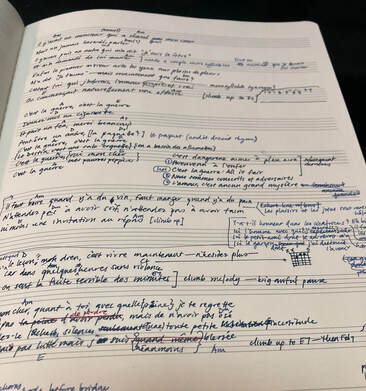
What has surprised me, though, is how much this has opened up other songs. I am not typically a riff-based songwriter, but as pinky movement has become more natural, several riffs have just sort of— appeared and offered themselves, as vocal melodies do. The notes and graces have become obvious. I am trying to live up to them. One became the lead-up to the chorus in "C'est la guerre"—I think it works?—and the others may or may not cohere into full songs. I don't really have a method for working this way; I have to figure that out too.

Anyway. I have been thinking about the intersection between playing and songwriting, and the ways performance shapes the body in turn. It's a given in acting and dance, but for some reason—despite the permanent quarter-inch of callus on my fingertips—I haven't thought about it so much in music. I don't have any big conclusions yet. Except of course it reshapes you, of course it changes you. So does everything worth doing.

*It does happen a bit more in classical guitar, where there are warmups devoted to achieving the four-fret stretch, but as my guitar background is not at all classical, this has been quite the learning curve.**
**Charlie's not the only one who can do footnotes!
0 Comments
<<Previous
Forward>>

    Liz Bagby

    Songwriter & multidisciplinary artist

    Archives

    July 2025
    April 2025
    January 2025
    October 2024
    July 2024
    June 2024
    April 2024
    March 2024
    December 2023
    November 2023
    October 2023
    September 2023
    August 2023
    July 2023
    June 2023
    May 2023
    April 2023
    March 2023
    November 2022
    October 2022
    July 2022
    June 2022
    May 2022
    April 2022
    March 2021
    January 2021
    November 2020
    October 2020
    September 2020
    August 2020
    July 2020
    May 2020
    April 2020
    March 2020
    February 2020
    January 2020
    December 2019
    November 2019
    August 2019
    July 2019
    March 2019
    February 2019
    January 2019
    October 2018
    September 2018
    August 2018
    July 2018
    April 2018
    February 2018
    January 2018
    September 2017
    August 2017
    June 2017
    May 2017

    Categories

    All
    Baked
    Guest Post
    Notebook Thursday

    RSS Feed

Proudly powered by Weebly